Prompt Engineering vs Context Engineering: Key Differences
AI development has reached a turning point. Teams have moved past debating which model to choose and now focus on the infrastructure surrounding those models. This evolution has brought prompt engineering and context engineering into sharp focus. Both methods guide models toward useful outputs, but they differ fundamentally in their ability to sustain accuracy when handling enterprise-scale complexity.
A well-crafted prompt or an overloaded context window might suffice for basic demonstrations with simple datasets, but these approaches buckle under the weight of actual business data. The real challenge lies in building context-aware agents that perform reliably in production environments. Understanding how prompt engineering and context engineering contribute to this goal is essential for teams building serious AI systems.
Understanding Prompt Engineering
Prompt engineering focuses on crafting instructions that make large language models produce more useful and predictable responses. The practice involves refining how you ask questions—tweaking the wording, providing examples, assigning specific roles to the model, or dictating how the answer should be formatted. Everything happens within a single exchange between user and model.
Where Prompt Engineering Works Best
This technique excels at straightforward, standalone tasks. Condensing a document, polishing an email draft, or interpreting a database query are all situations where prompt engineering delivers solid results. The method is fast to test, simple to deploy, and effective when all necessary information can be contained within the prompt itself.
Fundamental Constraints
Prompt engineering handles simple requests effectively, but struggles emerge when workflows become more intricate. What starts as a clean set of instructions rapidly expands into an unwieldy block of text crammed with business logic, formatting specifications, and special case handling.
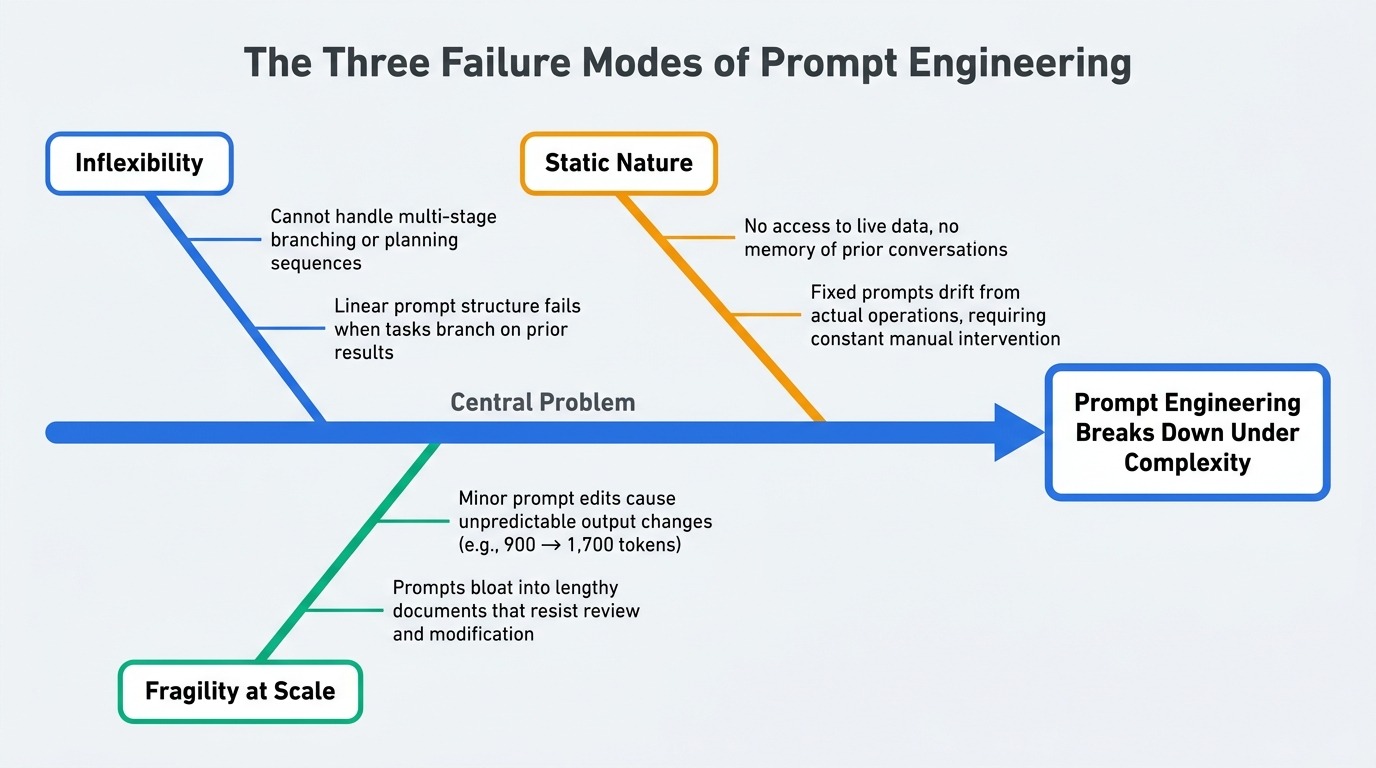
One practitioner noted that a minor adjustment to their system prompt caused average output length to jump from approximately 900 tokens to over 1,700 tokens—enough to disrupt their entire monthly budget. This illustrates a broader pattern of failure that manifests in three distinct ways.
First, prompt engineering lacks flexibility for complex operations. Multi-stage processes require coordination mechanisms like planning sequences and adaptive tool selection. Adjusting language alone cannot address these needs. When tasks must branch based on previous results, the linear nature of prompts creates a fundamental constraint.
Second, scaling becomes problematic. Minor modifications can trigger unexpected changes in output. Prompts gradually evolve into lengthy documents that resist both review and modification.
Third, prompts remain static. They cannot access current data, remember previous conversations, or adapt to changes in the systems they support. As business conditions shift, fixed prompts gradually lose alignment with actual operations. This disconnect grows wider over time, reducing the reliability of outputs and requiring constant manual intervention to maintain relevance.
Understanding Context Engineering
Context engineering transforms organizational knowledge into a structured context layer that enables large language models to deliver accurate, explainable, and reliable answers at enterprise scale. Shopify's Tobi Lütke captured the essence of this approach by defining context engineering as the practice of supplying all necessary context to make a task realistically solvable for an LLM.
Essential Building Blocks
Context engineering encompasses much more than simply feeding data to a model. A complete implementation typically integrates five distinct elements.
System prompts establish foundational behavior. They define the agent's communication style, functional role, and methods for handling uncertain situations.
Memory management expands the model's capacity to retain information. Short-term memory tracks the current conversation thread, while long-term memory preserves user preferences and working patterns.
External data keeps the model anchored to present reality. Real-time retrieval from documents, databases, data warehouses, and APIs enables the model to respond based on current business conditions rather than outdated training data.
Tools provide the agent with action capabilities. By defining available functions, you grant access to databases, APIs, and other critical business systems.
Output structure ensures responses remain useful for downstream processes. Enforcing specific formats like JSON schemas or standardized table structures makes the agent's output more actionable and easier to integrate with existing workflows.
Humans naturally interpret context through tone, body language, and shared experience—signals that machines cannot detect. Enterprise AI context functions as your organization's specialized language, and context engineering serves as the mechanism for delivering it effectively.
Inherent Limitations
Context engineering represents genuine progress beyond prompt engineering, but it does not solve every problem. Even well-designed context-engineered systems degrade over time—a phenomenon researchers identify as context rot or decay.
Research from Chroma, Anthropic, and independent analysts consistently demonstrates the same trend: LLM accuracy deteriorates as context expands, particularly when critical information becomes buried within lengthy inputs. Massive token windows offer no protection. Overloading context with excessive conversation history, files, or background information weakens the model's focus and increases hallucination risk.
In active business environments, context expands rapidly. Definitions evolve, reporting standards change, and new data sources continuously accumulate. Within months, your context layer becomes larger, less current, and less accurate than at launch.
Key Distinctions Between Prompt Engineering and Context Engineering
While prompt engineering and context engineering may appear similar on the surface, they differ fundamentally in how they operate and what they can accomplish. Understanding these distinctions helps teams choose the right approach for their specific needs.
Workflow Architecture
Prompt engineering places responsibility on the user. Developers typically construct prompts with business rules and data structures embedded directly within them. The user must anticipate every scenario and provide appropriate instructions upfront.
Context engineering shifts this burden to the backend infrastructure. Retrieval processes, orchestration logic, and query generation operate behind a natural-language interface. The system handles complexity automatically rather than requiring users to manage it manually.
Context Management Approach
Prompt engineering requires predicting the correct amount of context in advance for every conceivable question. This guessing game often results in either insufficient information or overwhelming the model with irrelevant details.
Context engineering retrieves only the specific information needed to address the current question. The system dynamically pulls relevant data at runtime, avoiding both information gaps and context overload.
Response Reliability
With prompt engineering, each question receives fresh interpretation. The model approaches every query as an independent task, which causes accuracy to fluctuate. Maintenance becomes increasingly burdensome as the system grows.
Context engineering maintains consistency by storing metric definitions, semantic mappings, and business rules in a unified context layer. Responses remain reliable because they draw from the same authoritative source every time.
Execution Capabilities
Prompt engineering primarily produces text-based output. When execution tasks like running queries, making API calls, or triggering data pipelines become necessary, developers must write separate code to handle these operations.
Context engineering integrates execution within the pipeline itself. The system retrieves data, makes decisions, invokes functions, validates results, and delivers output in a single coordinated workflow. This unified approach eliminates the disconnect between generating answers and taking action.
Operational Design Philosophy
The two approaches reflect fundamentally different design philosophies. Prompt engineering treats the model as a text generator that requires detailed instructions for each interaction. Context engineering treats the model as part of a larger intelligent system that can access resources, remember information, and execute operations autonomously. This architectural difference determines which approach can scale effectively in production environments where complexity, data volume, and business requirements continuously evolve.
Conclusion
The debate around prompt engineering vs context engineering reflects a broader maturation in how organizations approach AI implementation. Prompt engineering remains valuable for isolated tasks and rapid prototyping, but its limitations become apparent when systems need to scale, adapt, and integrate with complex business operations.
Context engineering addresses these challenges by creating a structured layer that manages data retrieval, memory, tool access, and output formatting. This architectural approach delivers consistent, explainable results that align with institutional knowledge and current business conditions. Yet even context engineering faces challenges as organizations grow and change. Context decay threatens accuracy over time as information accumulates and business rules evolve.
The solution lies in treating context as a dynamic, managed system rather than a static configuration. Organizations that succeed with enterprise AI recognize that context requires ongoing maintenance, governance, and adaptation. They build pipelines that can refresh definitions, update mappings, and incorporate new data sources without requiring complete reconstruction.
Teams building AI systems today must look beyond individual techniques and consider the entire architecture supporting their models. The question is not whether to use prompt engineering or context engineering in isolation, but how to combine these approaches within a framework that can evolve alongside business needs. As AI capabilities expand and enterprises demand greater reliability, the systems that win will be those designed for continuous adaptation rather than one-time deployment.