Physical Security Strategy Framework: How to Build a Scalable Security Program
A comprehensive physical security strategy defines the framework that guides every security decision across an organization—from personnel deployment to technology selection to incident response protocols. This framework aligns protective measures for personnel, facilities, and operations with broader business goals, acceptable risk levels, and the growing integration of physical security systems with information technology and cyber defense infrastructure.
Without a formalized strategy, organizations risk creating fragmented security programs where each location operates independently, leading to inconsistent protection levels and inefficient resource allocation. Leading organizations document their security strategy formally and subject it to regular executive review through established governance mechanisms, including oversight committees, standardized policies, compliance audits, and integration protocols for newly acquired entities.
This guide presents field-tested methods for developing a physical security strategy that functions effectively across global operations, delivers uniform results, maintains effectiveness during crisis situations, and earns executive confidence through quantifiable performance indicators and transparent operational accountability.
Defining Your Corporate Physical Security Strategy Charter
A well-crafted strategy charter serves as the foundational reference document that aligns leadership expectations with security team execution. This single-page document should be validated across partner departments and function as the decision-making filter for all subsequent security initiatives.
Crafting an Executive-Level Strategy Statement
Develop a concise statement that emphasizes business results—employee safety, operational continuity, asset protection, and brand reputation—rather than specific security technologies. The statement should be understandable to executives without requiring technical expertise. If your draft mentions specific equipment or systems, revise it until leadership can assess its value based solely on business impact.
Establishing Clear Responsibility Boundaries
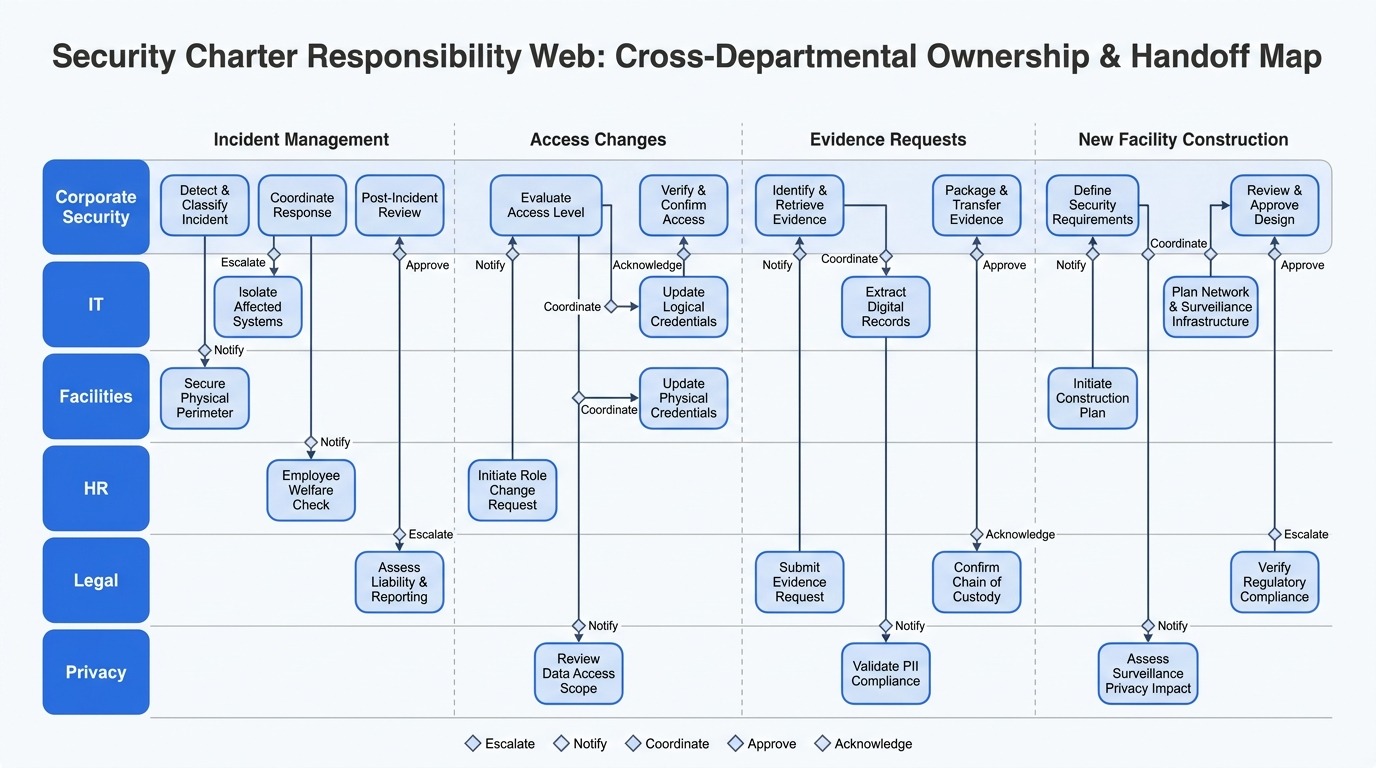
Explicitly define which functions corporate security directly controls, which are executed at the site level, and which require collaboration with IT, Facilities, Human Resources, Legal, or Privacy teams. Document these boundaries in straightforward language to prevent responsibility disputes during security incidents or project implementations. Conduct focused working sessions using a draft responsibility matrix and test it against realistic scenarios such as incident management, access modifications, evidence requests, and new facility construction. Transform these discussions into documented handoff points and escalation procedures, then obtain written acknowledgment from all parties to establish permanent clarity.
Creating Decision Principles for Future Tradeoffs
Establish a concise set of guiding principles that teams can apply when making security decisions. These might include defaulting to standardized solutions, calibrating controls to risk levels, prioritizing user experience, and demanding evidence to support performance assertions. Frame these principles so they provide practical guidance in real-world situations.
Identifying Measurable Strategic Objectives
Select three to five key outcomes that should demonstrate year-over-year improvement, such as reducing system downtime, eliminating coverage gaps, accelerating response times, achieving baseline compliance, or enhancing crisis preparedness. Keep these objectives technology-neutral and establish specific metrics and measurement methods separately. Align these objectives with your program's current maturity level—emerging programs should emphasize establishing consistent baselines, developing programs should focus on reducing variances and accelerating remediation, while advanced programs should concentrate on resilience metrics, lifecycle management, and quantifiable risk reduction.
Validating and Publishing the Charter
Review the charter to remove unnecessary details such as organizational charts, system inventories, or project timelines. Confirm boundary definitions with partner teams, then distribute the document to executive leadership as the authoritative foundation for governance and operational execution.
Building Governance Frameworks and Decision Authority
After establishing your charter, immediately implement governance structures that enable consistent strategy execution across all locations. This framework functions as your operational backbone, clarifying who establishes standards, who authorizes modifications, how resources are allocated, and how deviations are managed without creating permanent vulnerabilities.
Creating a Decision Authority Map
Publish a single-page reference document that identifies approval authority for standards modifications, budget allocations, and policy exceptions at corporate, regional, and local facility levels. Standardize the information required for these decisions by developing a funding prioritization framework and a mandatory exception documentation packet. This packet should include business justification, accepted risks, alternative compensating measures, assigned ownership, and expiration timelines. Deploy these tools within a regular governance rhythm to ensure approvals remain consistent and all deviations stay visible with defined time limits.
Designating Standards Ownership and Approval Workflows
Identify specific owners for policies and standards documentation, and clearly delineate which decisions can be made locally versus those requiring escalation to corporate leadership. Maintain centralized control over enterprise-wide standards to prevent inconsistencies from developing across different regions and business units.
Focusing Governance on Alignment Rather Than Control
Deploy governance mechanisms to validate strategic alignment and address gaps while preserving site-level autonomy for daily operations. Consider a regional facility that satisfies mandatory access control requirements but implements a customized guard rotation schedule based on location-specific threats. Governance oversight should verify that required protective measures are operational and effective, not prescribe operational details like staffing arrangements or workflow sequences unless baseline standards are compromised. Concentrate on confirming whether minimum requirements are satisfied, exceptions have proper authorization, and remediation timelines are being honored. Permit facilities flexibility in execution methods provided outcomes remain consistent with enterprise standards.
Implementing a Consistent Investment Prioritization Model
Establish a repeatable framework for evaluating and ranking security investments. This model should weigh factors such as risk severity, potential business impact, regulatory obligations, and strategic alignment. A transparent prioritization approach prevents ad-hoc decision-making and ensures resources flow toward the highest-value security initiatives. Document the criteria and scoring methodology so stakeholders understand how funding decisions are made, and apply this framework consistently across all investment requests to maintain fairness and strategic focus throughout the organization.
Converting Risk Assessment Into Enterprise Security Baselines
Effective security strategies require a systematic method for translating risk evaluation into specific control requirements. This approach ensures that protection levels correspond appropriately to threat exposure and asset criticality rather than relying on inconsistent site-by-site judgments.
Developing a Risk-to-Requirements Framework
Establish a repeatable methodology that classifies facilities and critical assets according to standardized criteria, then derives minimum security control baselines for each classification tier. This framework should account for factors such as asset value, operational criticality, threat environment, regulatory requirements, and potential business impact from security failures. The classification system provides the foundation for determining which security measures are mandatory versus optional at each location.
Creating Tiered Security Baselines
Define distinct security tiers that specify required controls for different facility classifications. A basic tier might apply to low-risk administrative offices with standard access control and video surveillance. A moderate tier could address distribution centers or research facilities requiring enhanced perimeter protection, intrusion detection, and visitor management. A high tier would cover critical infrastructure, data centers, or executive facilities demanding advanced access authentication, comprehensive surveillance coverage, security personnel, and redundant systems. Document the specific controls required at each tier to eliminate ambiguity during implementation.
Implementing Control Enhancements Based on Specific Threats
Beyond baseline requirements, identify circumstances that warrant additional security layers. These enhancements might address location-specific threats such as elevated crime rates, geopolitical instability, or proximity to high-risk areas. They could also respond to asset-specific factors like intellectual property concentration, hazardous materials storage, or high-value inventory. Document the triggers that require enhanced controls and the specific measures that address each scenario.
Maintaining Consistency Through Standardized Assessment
Apply your risk classification framework uniformly across the entire organization to prevent subjective interpretations from creating protection gaps or inefficient resource allocation. Train regional security leaders on the assessment methodology and provide decision-support tools such as classification worksheets or automated assessment platforms. Conduct periodic reviews to verify that facility classifications remain accurate as business operations evolve, threat landscapes shift, or asset profiles change. This disciplined approach transforms risk management from an abstract concept into concrete security requirements that can be implemented, measured, and audited across global operations, ensuring that protection investments align with actual risk exposure.
Conclusion
A robust corporate physical security strategy transforms fragmented protection efforts into a cohesive enterprise capability that directly supports business objectives. Organizations that formalize their approach through clear charters, structured governance, risk-based baselines, and defined operational models achieve measurably better outcomes than those relying on decentralized decision-making.
The foundation begins with documenting strategic intent in language that resonates with executive leadership—emphasizing business continuity, personnel safety, and asset protection rather than technical specifications. From this foundation, governance structures ensure decisions remain consistent across regions while preserving necessary operational flexibility at individual sites. Risk-based frameworks then translate abstract threats into concrete control requirements, eliminating guesswork and ensuring protection levels match actual exposure.
Success requires moving beyond initial documentation to establish living processes. Regular governance reviews keep standards current and exceptions time-bound. Standardized assessment methodologies ensure new facilities and evolving threats receive appropriate attention. Performance metrics provide visibility into program effectiveness and identify improvement opportunities before gaps become incidents.
Organizations that implement these practices build security programs that scale efficiently, respond effectively to disruptions, satisfy compliance obligations across jurisdictions, and earn sustained executive confidence. The investment in strategic formalization pays dividends through reduced redundancy, faster decision-making, improved incident outcomes, and the ability to demonstrate security value in business terms. By treating physical security as a strategic discipline rather than a tactical function, organizations position themselves to protect what matters most while supporting growth and operational excellence.