Securing a text-generating model and securing an AI agent are fundamentally different problems. The first wave of AI security tooling was built for the former: it inspected prompts and responses to catch unsafe outputs or leaked sensitive data. Agents demand far more, because they don't stop at generating text—they call tools, execute code, read and write data, and delegate work to other agents. Each of those capabilities opens a new attack surface, where a single malicious instruction can push an agent toward an unauthorized action instead of just an unsafe reply.
The tools built to address this expanded risk surface fall into four distinct categories: adversarial testing, tool and configuration scanning, runtime isolation, and the agent security control plane. This article walks through each category in the sequence you'd naturally encounter them while building and running an agent—from development and testing, through staging, and into production.
Along the way, you'll see the leading tool in each category: Promptfoo for adversarial testing, Snyk Agent Scan for tool and configuration scanning, E2B for runtime isolation, and Trust3 AI for the control plane layer.
Of these four, the control plane occupies a distinct position. It forms the backbone of modern AI agent security posture management, discovering agents across an organization's environments, enforcing policy continuously from the moment an agent is built through every action it takes at runtime, and preserving a complete audit trail. In doing so, it closes the gaps that testing, scanning, and sandboxing alone cannot cover.
By the time you finish this article, you'll be equipped to recognize the specific threats facing your AI agents and match each one to the right security tool.
What AI Agent Security Tools Protect Against
An AI agent carries a fundamentally different risk profile than a standard language model. It doesn't just generate text—it reasons through problems, makes decisions, takes action, and adapts based on outcomes. This means invoking tools, executing code, modifying data, and passing tasks along to other agents. A text generator that gets something wrong produces a flawed sentence. An agent that gets something wrong can execute a real-world action that can't be undone.
Common AI Agent Security Threats
The OWASP GenAI Security Project catalogs these risks across its Top 10 lists for LLM Applications and Agentic Applications, giving the industry a shared vocabulary for the threats agents introduce.
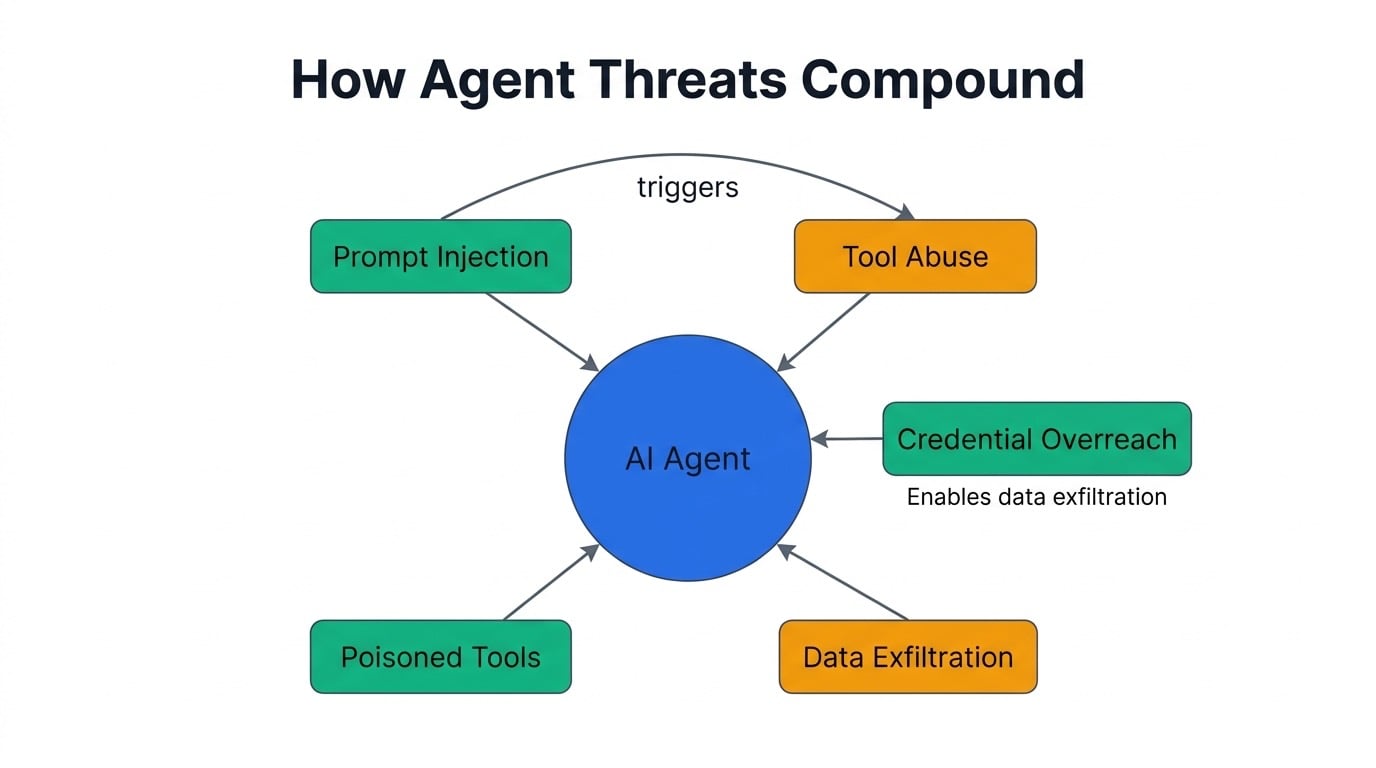
Prompt Injection
Prompt injection tops OWASP's threat list for good reason: a model cannot reliably tell the difference between a legitimate instruction and malicious text buried inside content it's processing. An attacker can embed commands directly in a user's prompt, or indirectly through a tool description, a retrieved document, or output passed from another agent—and the agent may carry out the hidden instruction as if it were authorized.
Tool Abuse and Excessive Agency
Tool abuse happens when an agent is manipulated into calling a tool outside its intended scope—for instance, tricking a support agent into issuing a refund when it was only supposed to look up refund eligibility. This becomes possible because of excessive agency: giving an agent more tools, more power, or more autonomy than its actual job requires.
Credential Overreach
Agents often operate with real credentials, and those credentials grant access well beyond what the agent's task actually needs. A reporting agent might have a perfectly scoped tool, but if its underlying database login also reaches payroll or customer records, a compromised request can pull all of it.
Data Exfiltration
Exfiltration emerges from what's known as the "lethal trifecta"—an agent that can access private data, read untrusted content, and send data externally. When all three conditions line up, no software bug is even necessary; a prompt injection alone can extract and leak secrets.
Identity Loss, Poisoned Tools, and Agent-to-Agent Risk
When agents share credentials, backend systems lose visibility into which agent is actually making a request, enabling the "confused deputy" problem. Malicious MCP tool descriptions, rug-pull updates, and insecure server configs can poison the tools agents trust—threats already observed in incidents like the postmark-mcp package and the Shai-Hulud worm. These risks compound in multi-agent chains, where a compromised agent can silently pass corrupted instructions downstream.
Red-Teaming Tools That Test the Agent Before It Ships
NIST's Generative AI Profile frames AI red-teaming as a structured exercise for probing a system's weaknesses, positioning it as a core risk-management practice. Applied to agents, red-teaming tools throw adversarial scenarios at the system—prompt injections, jailbreak attempts, PII leaks, and tool-level failures like broken authorization or excessive agency—with the goal of surfacing flaws before the agent ever reaches production.
Leading Tools in This Space
Promptfoo, NVIDIA Garak, and Microsoft PyRIT have emerged as the most widely adopted tools for this kind of adversarial testing. Promptfoo in particular is an open-source, MIT-licensed command-line tool designed for red-teaming both LLMs and agents. It's config-driven and built to slot into local development as well as CI pipelines. Notably, OpenAI announced its acquisition of Promptfoo in March 2026, confirming the tool would stay open source under its existing license.
How Promptfoo Works
Promptfoo generates adversarial test cases and fires them at your agent, either through an HTTP endpoint or a direct function hook. What sets it apart is a set of agent-aware plugins that go beyond checking for unsafe text—they probe authorization boundaries and agency limits too.
On the authorization side, RBAC plugins confirm the agent respects its assigned role boundaries, BOLA plugins test whether it can be tricked into exposing another user's data, and BFLA plugins check whether it can be manipulated into calling functions outside its permitted scope. Beyond authorization, the plugin suite also tests for excessive agency, tool discovery vulnerabilities, and indirect prompt injection.
Teams configure these tests through a config file, specifying the target system, which vulnerability categories to test, and which attack strategies to apply—ranging from simple single-shot injection attempts to multi-turn escalation sequences designed to wear down the agent's defenses over several exchanges.
Once testing completes, Promptfoo produces a report organized by vulnerability type and severity level. Each finding includes the specific attack that succeeded, how the agent responded, and which OWASP category the issue maps to.
The Limits of Point-in-Time Testing
Red-teaming answers one question: does the agent break when given a bad input? But it's a snapshot, not an ongoing safeguard—it can't watch for or stop threats once the agent is live. A clean red-team report on Monday tells you nothing about a prompt-injected document the agent encounters on Tuesday.
Scanners That Vet the Tools Your Agent Trusts
Beyond testing the agent itself, a separate class of tools focuses on vetting what the agent connects to. Snyk Agent Scan, Cisco AI Defense MCP Scanner, and MCP-Shield examine MCP servers and the tool descriptions they expose, while NVIDIA SkillSpector performs a similar inspection on agent skills.
How Snyk Agent Scan Works
Snyk Agent Scan runs with a single command and starts by scanning your agent's configuration files to map out which MCP servers and skills are actually connected. From there, it launches each one to pull its tool descriptions, then checks both the servers and their descriptions for tool poisoning, embedded prompt injection, and cross-server shadowing—a technique where a malicious server's tool mimics a trusted tool from another server. Because the scan works from the configuration file rather than just the exposed descriptions, it can flag a potentially malicious server even if it's wired in but hasn't been invoked yet.
Four Things to Watch Out For
Despite its usefulness, there are limitations worth understanding before relying on Snyk Agent Scan. First, the tool transmits your configs and tool descriptions to Snyk's API, redacting detected secrets beforehand—but sensitive configurations still warrant a manual review of what's being sent. Second, reading a server's tools requires actually starting that server, which means running its code. If you don't trust the config being scanned, running the scanner inside an isolated sandbox with restricted filesystem and network access limits what a malicious server could reach. Third, a scan only captures a tool's state at a single moment, so it won't catch a rug pull where a tool is altered after it passes inspection. Fourth, the scan has no visibility into what happens after a tool is approved and put into use—vetting happens pre-run, but an agent can still misuse a legitimate tool once it's live.
Why Pre-Load Scanning Matters
Tool poisoning and supply-chain risks aren't hypothetical. Malicious packages distributed through public registries, hidden instructions embedded in tool descriptions, and servers configured with excessive permissions have all surfaced in real deployments. Scanning configurations and tool descriptions before an agent ever loads them closes off an entire class of attack that red-teaming tools, which test the agent's behavior rather than its dependencies, aren't designed to catch.
Conclusion
AI security has had to evolve alongside what AI systems actually do. Filtering prompts and responses made sense when models only produced text, but agents call tools, execute code, and read and write data—so protecting them requires controlling not just what an agent says, but what it's permitted to do and reach. This is the core reason ai agent security tools have diversified into distinct categories rather than converging on a single solution.
Each category addresses a different point in an agent's lifecycle. Red-teaming tools like Promptfoo probe for weaknesses before an agent ever ships. Scanners such as Snyk Agent Scan vet the tools and MCP configurations an agent is about to trust. Sandboxes like E2B contain what the agent's code can actually touch once it's running. None of these three, on their own, tracks an agent across its full lifecycle or continuously checks whether its actions are authorized—that responsibility falls to the control plane.
A control plane such as Trust3 AI closes this gap by following an agent from the moment it's registered through every action it takes in production. It discovers agents across an organization's environments—including the shadow agents nobody signed off on—logs their activity in a replayable audit trail, and enforces policy at the gateways and data sources where real damage would otherwise occur.
No single tool covers every threat an agent faces. The organizations that get this right combine testing, scanning, isolation, and continuous policy enforcement into one coherent strategy, rather than treating any one layer as sufficient on its own.
\
Comments
Join the discussionNo comments yet. Be the first to comment.